
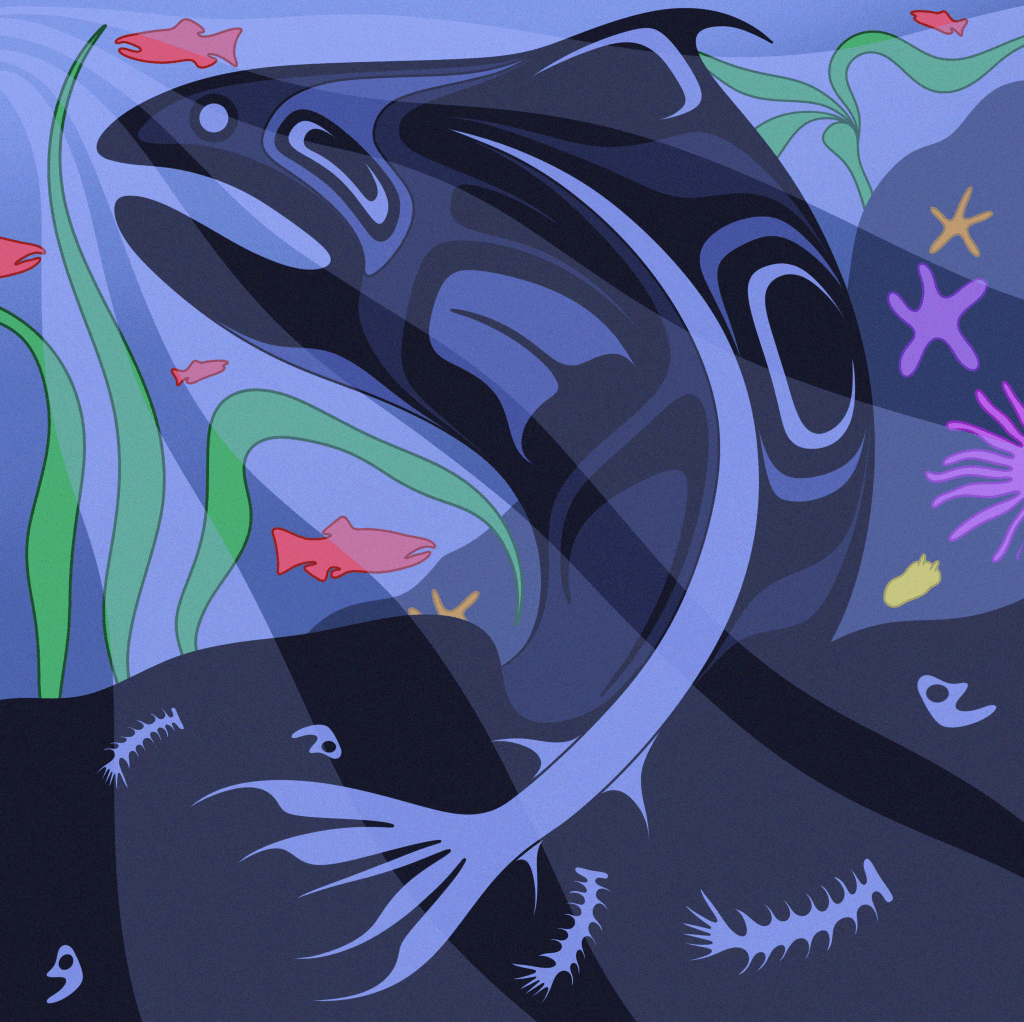
Art by Movement 74 (movement74.ca)
I’m pleased to share a new paper out in Nature Reviews Biodiversity, co-led with Jared W. H. Connoy and written together with Janessa Esquible, Lawrence Ignace, Jonathan W. Moore, Nigel C. Sainsbury, and Andrea J. Reid. The paper is titled “Pacific salmon and cumulative injustices in Canada and the USA,” and it was published online on May 5, 2026. You can access it for free via this link. If you don’t have institutional access and would like a PDF copy, please email me, and I’d be happy to share one.
The piece looks at the governance and management of wild Pacific salmon through a lens of equity and justice for Salmon Peoples across the US and Canada. We build on four dimensions of equity already present in the conservation literature (recognitional, procedural, distributional, and contextual) and propose a fifth: epistemic equity. By that, we mean the inclusion, respect, intergenerational transmission, and flourishing of Indigenous knowledge systems, going beyond recognition to address the disruption of Indigenous epistemologies, ontologies, and axiologies. Fishing itself is central here, because it’s through fishing that languages, legal traditions, and knowledge systems are practised and shared.
We also introduce the concept of cumulative injustices, which we define as layered harms that accumulate over time and space, compounding across generations in ways that disproportionately burden Salmon Peoples and the salmon they have stewarded for millennia. We wanted to capture something that intersectionality and “double exposure” frameworks don’t fully address, namely how colonial harms, environmental degradation, and systemic inequity are inseparable rather than parallel, and how they affect both people and salmon as interconnected kin.
The body of the paper walks through several of the major threats facing wild salmon (mixed-stock marine fisheries, hatcheries, open-net pen Atlantic salmon aquaculture, dams and migration barriers, extractive industries, and climate change) and traces how each one produces specific forms of inequity. We close with what transformative justice could look like in practice, drawing on examples like the Syilx Okanagan Nation’s sockeye restoration work and the səlilwətaɬ (Tsleil-Waututh) Nation’s restoration of the xʷəĺilwətaʔɬ (Indian River).
A note on the experience of writing this one. The author team includes Indigenous Salmon Peoples with inherent rights and responsibilities to salmon, as well as settler scholars like me. Working across those positionalities meant many deliberate conversations about word choice, framing, and what was ours to say. Some sections went through many drafts because what reads as a neutral description in conservation science can carry a different weight depending on who’s writing it and who’s being written about. I learned a lot from that process, and from being asked to sit with something rather than smooth it over.
For settler scientists who read the paper: the parts that are hardest to sit with are probably the parts worth staying with. Most of us weren’t trained to think about whose decisions our research informs, or about the governance systems we work within and are funded by. That’s a real gap, and I don’t think there’s a tidy way to close it. My decolonizing conservation reading list is where I keep some of what I’ve found useful, if it’s helpful to anyone else.


2 responses to “Pacific salmon and cumulative injustices in Canada and the USA”
Sara
When I click on the link, it tells me ‘page not found.’ I would like to have a pdf copy to read.
Regards,
Margaret Jean Cannon (Jean) Margaret Jean Cannon Director and Secretary STUG, Refurb Project mjcannon@gmail.com (941) 313-0559
Never underestimate the power of a small group of committed people to change the world. In fact, it is the only thing that has ever changed it. Margaret Mead
Thanks Jean, I’ve just fixed the link and emailed you a PDF!